Wrenze Steel designs cellular and castellated steel beams for contractors, fabricators and consultants in Dubai, across the UAE and in the GCC. Both are steel sections with a row of openings along the web. They are deeper and stiffer than the section they are made from, for the same weight of steel, so they span further, deflect less and let services pass through the beam instead of below it.
Cellular and castellated beams explained
A castellated beam is made by cutting the web of an I-section along a zigzag line, shifting the two halves and welding them back together. The result is a deeper beam with hexagonal openings. A cellular beam is made the same way with a curved cutting line, which gives round openings. Round openings spread the stresses more smoothly around each hole and suit round ducts, so cellular beams are the more common choice in modern buildings.
What we design
- Cellular beams: roof and floor beams with round web openings, as primary beams, secondary beams and rafters
- Castellated beams: beams with hexagonal openings for roofs, platforms and frames
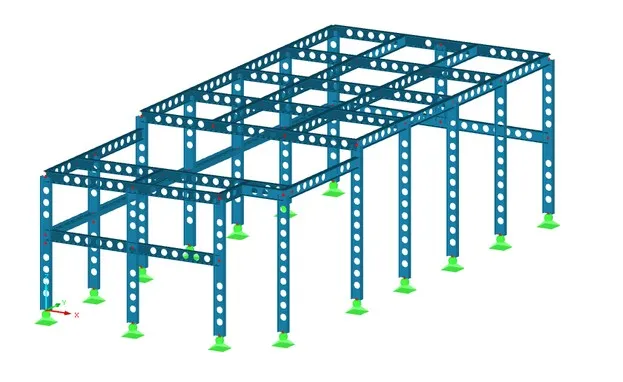
- Columns with web openings: cellular columns for exposed frames, as on the B1 Mall terrace
- Composite cellular beams: cellular beams acting with a concrete slab on metal deck, through our composite steel design service
- Opening layouts: spacing, size and position of openings, with filled or stiffened openings where forces are high
- Connections: beam-to-column and splice connections that suit the opening pattern
What the design checks
A beam with web openings has more ways to fail than a plain beam, so each part is checked:
- Bending and shear at each opening. The section is weakest where the web is cut, so the top and bottom tees are checked for bending, shear and their combined effect.
- Web posts. The web between two openings is checked for buckling and for the shear passed along the beam.
- Lateral-torsional buckling. Long, deep beams are checked for buckling with their real restraints from the roof or floor.
- Deflection and vibration. Including the extra deflection caused by the openings, and floor vibration for offices and walkways.
- Welds. The welded seam along the web, where the two halves are joined.
- Supports and point loads. Openings near supports and under heavy loads are filled or stiffened where needed.
Codes and design guides
We design to AISC 360 with AISC Design Guide 31, or to Eurocode 3 with the SCI guidance on beams with large web openings, following the project specification. The frame is analysed as a 3D model, and the openings are checked one by one with our own spreadsheets and hand checks. The approved design then goes to shop drawings and detailing, where the opening pattern is set out for cutting.
Where they fit best
- Long-span roofs for warehouses, sports halls and showrooms
- Car parks and office floors where services must run through the beam depth
- Malls, terraces and exposed frames where the steel is part of the look
- Mezzanines and platforms that need long spans with light steel
Cellular steel project
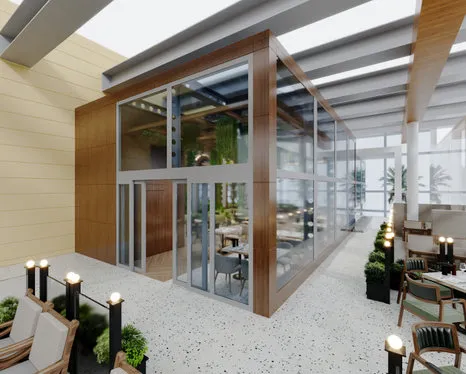
On the B1 Mall terrace in Dubai, Wrenze Steel carried out the structural design for CBD Projects. The frame uses cellular sections throughout, beams and columns, with the stability coming from rigid beam-to-column connections, which keeps the dining terrace open and gives the exposed steel a light look.
Related services
Cellular and castellated beams are part of our structural steel design work. Their joints are covered by steel connection design, long-span roofs by warehouse and PEB design, and composite floors by composite steel design.
Contact our engineers
For cellular and castellated beam design, contact our engineers.