
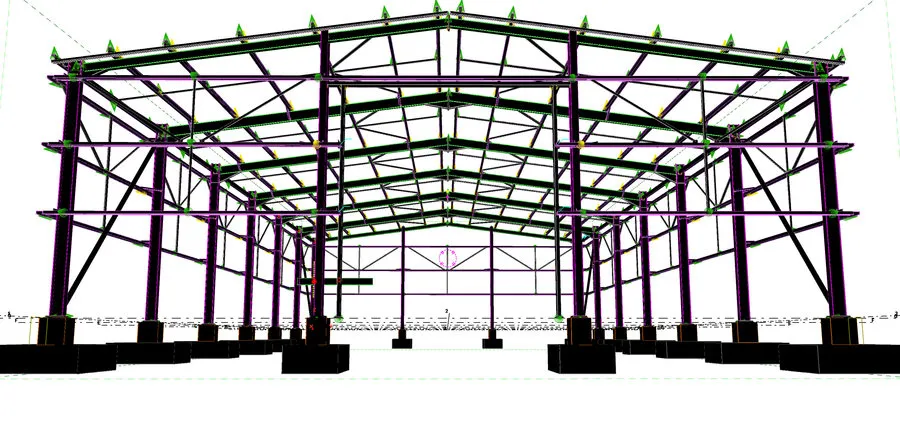
Steel weight calculation is the starting point of every steel estimate, purchase order and fabrication price. Steel is bought, fabricated, galvanised, transported and erected by the tonne, so a small error in the weight of a repeated member becomes a large error in the project cost. The good news is that every steel weight comes from one number, the density of steel, and a few simple formulas.
The one number: steel density
Carbon steel has a density of 7,850 kg/m³. Every formula below comes from it:
Weight (kg) = volume (m³) × 7,850
Two handy forms of the same number:
- A steel plate 1 m² in area and 1 mm thick weighs 7.85 kg.
- A steel member with a cross-section area of 1 mm² weighs 0.00785 kg per metre of length.
So for any section: weight per metre (kg/m) = cross-section area (mm²) × 0.00785. Stainless steel is slightly heavier (around 7,900 to 8,000 kg/m³, depending on the grade), so use the supplier’s figure for stainless work.
Steel weight formulas by shape
| Shape | Formula | Units |
|---|---|---|
| Plate or flat bar | length × width × thickness × 7.85 | m × m × mm → kg |
| Round bar or rebar | d² ÷ 162 | d in mm → kg/m |
| Square bar | a² × 0.00785 | a in mm → kg/m |
| Circular hollow section (pipe) | (D − t) × t × 0.02466 | D, t in mm → kg/m |
| Square or rectangular hollow section | (2 × (B + H) − 4t) × t × 0.00785 | B, H, t in mm → kg/m (approximate) |
| Any other section | area (mm²) × 0.00785 | kg/m |
The rebar formula d²/162 is the one most site engineers in the Gulf know by heart: it is the round bar formula with π/4 and 7,850 folded into one number.
The hollow section formula ignores the rounded corners, so it slightly overestimates. For final quantities, use the manufacturer’s section tables.
Worked examples
Steel plate. A base plate 2,000 × 1,000 × 10 mm: 2 m × 1 m × 10 mm × 7.85 = 157 kg.
Round bar. A 16 mm bar or rebar: 16² ÷ 162 = 256 ÷ 162 = 1.58 kg/m. A 12 m bar weighs about 19 kg.
Pipe (CHS). A 168.3 × 6.3 mm circular hollow section: (168.3 − 6.3) × 6.3 × 0.02466 = 25.2 kg/m.
Square hollow section. A 100 × 100 × 5 mm SHS: (2 × (100 + 100) − 4 × 5) × 5 × 0.00785 = 14.9 kg/m. The table value is about 14.7 kg/m, slightly lower because of the rounded corners.
Built-up girder. A welded plate girder, common in PEB frames: two flanges 250 × 12 mm and a 600 mm deep section with a 6 mm web. The web between the flanges is 600 − 2 × 12 = 576 mm. Area = 2 × 250 × 12 + 576 × 6 = 6,000 + 3,456 = 9,456 mm² Weight = 9,456 × 0.00785 = 74.2 kg/m.
For tapered PEB members, where the web depth changes along the length, use the average web depth over each segment.
Rolled sections: the weight is in the name
For standard hot-rolled beams and columns you don’t calculate, you read the weight from the section tables. Some typical values:
| Section | Weight (kg/m) |
|---|---|
| IPE 200 | 22.4 |
| IPE 300 | 42.2 |
| IPE 400 | 66.3 |
| IPE 500 | 90.7 |
| HEA 200 | 42.3 |
| HEA 300 | 88.3 |
| HEB 200 | 61.3 |
| HEB 300 | 117 |
British sections carry the weight in their name: a UB 305 × 165 × 40 weighs 40 kg/m. American W sections carry it in pounds per foot: a W12×26 weighs 26 lb/ft, which is 26 × 1.488 = 38.7 kg/m. On US projects, also watch the tonne: a US “ton” (short ton) is 907 kg, not 1,000 kg.
From member weight to project tonnage
A steel weight calculation for a whole building is more than the sum of the beams and columns. The items that change the final number:
- Connections. End plates, cleats, stiffeners, gussets, base plates and bolts. On a modelled project they are measured from the connection design; at tender stage they are an allowance, and it should be stated clearly in the estimate.
- Secondary steel. Purlins, girts, sag rods, bracing, eave struts, flange braces, door framing and canopies. On warehouses these are a significant share of the total, so leaving them to “sundries” hides real tonnage. See our guide to purlins.
- Net vs gross weight. The drawings give the net weight of the finished members. The steel bought is heavier: standard stock lengths, offcuts and plate nesting losses. Keep the two figures separate, and state which one a price is based on.
- Galvanising and coatings. Galvanisers charge by the weight of the steel, and the zinc adds weight. Paint adds very little. Fire protection boards or intumescent coatings are priced by area, not weight.
- Welds. Weld metal is usually ignored in tonnage, which is accepted practice, but heavy built-up members carry more of it.
Calculating steel weight from a 3D model
On modelled projects, the tonnage comes from the detailing model in Tekla Structures or Advance Steel: every member, plate and bolt has a weight, and the software reports it by assembly, by phase or by member type. Two checks are worth doing every time:
- Spot-check the model. Take a few members and calculate them by hand with the formulas above. If a section was modelled with the wrong profile or thickness, this is where it shows.
- Check what the report includes. Some reports list net weight only, some include bolts, and some leave out items modelled as “reference” objects.
Common mistakes in steel weight calculation
- Mixing units: millimetres with metres, or kg/m with kg per member.
- Using the outside dimensions of a hollow section as if it were solid.
- Forgetting the second flange or the stiffeners on a built-up member.
- Using lb/ft weights as kg/m on US-designed sections.
- Leaving out secondary steel and connections, then finding the “missing” tonnes at fabrication.
- Pricing the net weight but buying the gross weight.
Steel weight in Wrenze projects
Quantity take-off is part of our engineering work. On the sports centre in Dubai, quantity estimation was taken from the same BIM model as the structural design, so the quantities matched the drawings. At tender stage, a preliminary design gives contractors a realistic steel weight to price instead of a rough rate per square metre.
Steel weight questions
What is the density of steel?
Carbon steel is 7,850 kg/m³. A 1 m² plate 1 mm thick weighs 7.85 kg.
How do I calculate the weight of a steel plate?
Multiply length (m) × width (m) × thickness (mm) × 7.85 to get the weight in kg.
What is the formula for rebar weight?
Weight in kg per metre = d² ÷ 162, with the bar diameter d in mm. A 12 mm bar weighs about 0.89 kg/m.
How do I convert lb/ft to kg/m?
Multiply by 1.488. A W12×26 section at 26 lb/ft weighs about 38.7 kg/m.
Related
Steel quantity take-off · Shop drawings and detailing · Purlins in steel buildings
For steel quantities and tonnage on your project, contact our engineers.