Wrenze Steel provides steel moment connection design services for real estate developers, engineering consultancies, contractors and steel fabricators in Dubai, across the UAE and in the GCC. A moment connection transfers bending as well as shear between a beam and a column, or between two parts of a frame, so it decides how stiff the frame is and whether the structure behaves the way it was analysed. It is also one of the most expensive details to fabricate. We design moment connections to carry the forces safely with as few bolts, welds and stiffeners as the code allows, and issue calculations that a reviewer can follow line by line. Moment connections are one part of our steel connection design service.
Moment connection types we design
- Extended end plate: the end plate projects beyond the beam tension flange, with bolt rows above and below the flange. It carries larger moments and is the usual choice for rigid beam-to-column joints.
- Flush end plate: the plate stays within the beam depth. It suits lower moments and joints where a projecting plate would clash with slabs, decks or cladding.
- Welded flange connection: the beam flanges are butt-welded to the column, with a bolted or welded web connection for shear. We prefer the welding done in the shop, with a bolted site splice further along the beam, because site welding is slower and harder to control.
- Bolted flange plates: flange plates welded to the column and bolted to the beam flanges on site.
- Haunched portal knee and apex: the eaves and apex connections of portal frames, with a haunch cut from a rolled section or built up from plate to increase the lever arm of the bolts.
- Beam and column splices: moment splices placed where they suit transport and erection.
Our guide to types of steel connections explains how rigid, pinned and semi-rigid joints differ.
Moment connection design approach
Bolts and prying
The tension from the moment is carried by the bolt rows near the tension flange. As the end plate bends, prying forces develop at its edges and add to the bolt tension. We check each bolt row for tension with prying, using the equivalent T-stub method or the AISC design guides for end plates, and check the bolts near the compression flange for shear. Bolt grade and pretensioning follow the project specification.
End plate and welds
The end plate thickness is set by its bending between the bolts, the beam flange and the web. A thin plate saves steel but increases prying; a thick plate reduces prying but costs more and may need larger welds. We size the plate and the welds together and choose the balance that keeps the bolt count low.
Column flange, web and panel zone
The column has to take the connection forces too. We check column flange bending at the tension bolts, the column web in tension and in compression (local yielding, crippling and buckling), and the column panel zone in shear, where the moments from the beams on each side are resolved. On frames with beams on both sides of the column, the panel zone often governs.
Stiffeners and haunches
Where the column cannot carry the forces on its own, we add stiffeners: horizontal web stiffeners in line with the beam flanges, end plate stiffeners on extended plates, diagonal stiffeners or supplementary web plates for panel zone shear. Before adding them, we check whether a different bolt arrangement, a thicker plate or a slightly heavier column removes the need, because each stiffener adds fabrication time.
Stiffness and the frame model
A moment connection must be as stiff as the frame analysis assumed. A joint modelled as rigid that behaves as semi-rigid changes the moments and the sway of the frame. We classify the joint stiffness where the code requires it, and make sure the connection and the frame analysis match.
Finite element connection analysis and hand checks
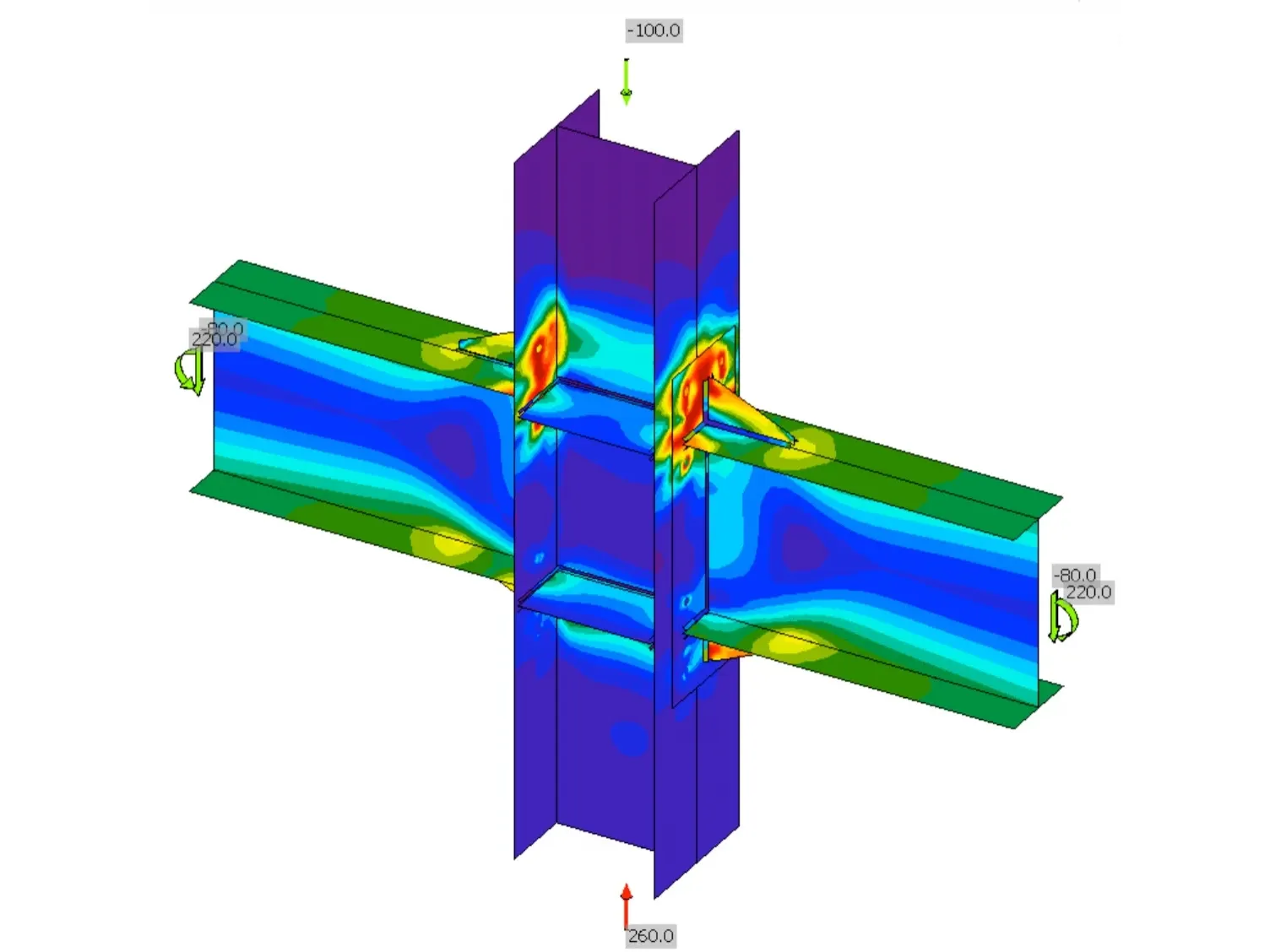
For joints with unusual geometry, several members or many plates, we use finite element connection analysis to model the plates, bolts and welds and review the stresses and strains in each part. Standard end plate connections are designed by the component method, and key results are checked by hand. The calculation report shows the governing load combination and every check in a clear order.
Codes
We design moment connections to AISC 360 with the AISC design guides for end plate connections and column stiffening, to BS EN 1993-1-8, or to BS 5950, following the project specification. Where a ductile moment frame is required for seismic design, the connection follows AISC 358 and AISC 341.
What you receive
- A calculation report for each moment connection type, with design forces, the governing combination and each check
- Connection sketches with plate sizes, bolt sizes, grades and positions, weld sizes and stiffeners
- Finite element connection analysis output where a joint has been checked with it
- A summary sheet for the detailers, so the approved connections go into the model unchanged
- Responses to the consultant’s comments until the connections are approved
Moment connection design services: how a project runs
- You send the design drawings, the member forces and the specification.
- If forces are not available, we agree the design basis with the consultant first.
- We group the connections into types and take the governing forces for each type.
- We design and check each type, then adjust it for economy and fabrication.
- We issue the calculations and sketches for approval and answer the comments.
- Our shop drawings and detailing team can take the approved connections into the 3D detailing model.
Projects with steel connection design
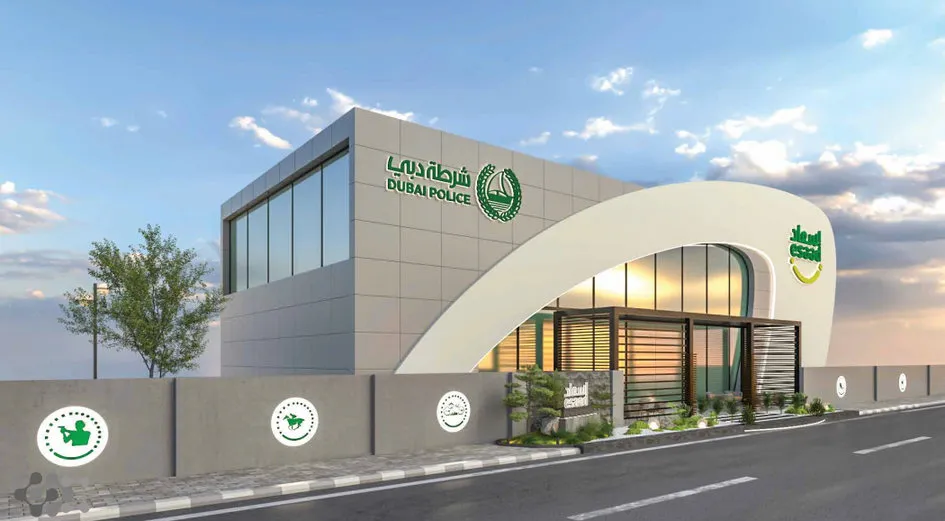
Our scope on the Esaad Building for Dubai Police, with Al Bayt Al Jamil Consultancy as consultant, covered structural steel design and detailing, connections included. On Crown Icon Bay Tower at Dubai Creek Harbour, a G+43 tower, we carried out the steel modelling and design for Emirates Steel, checking the steel members and their connections for the project loads.
Why choose specialist steel moment connection design consultants
- Our engineers hold Dubai Municipality practice certificates, and we prepare Dubai Municipality submissions through to approval.
- One team handles the steel design, the connection design and the detailing.
- Our connection reports are written for the reviewer: forces, checks and results in a clear order.
- 96 projects completed across the UAE and the GCC.
- Our office is in Dubai Silicon Oasis, and we work across the UAE and the GCC.
Related pages
Steel connection design · Base plate and anchor bolt design · Warehouse and PEB design · Steel design verification · All steel connection types
For steel moment connection design, contact our engineers.