Stainless steel structure design in Dubai starts from the environment: salt air on the coast, humid and chlorinated air at pools, irrigation water in landscapes and the visible finish of exposed architecture. Wrenze Steel provides structural design of stainless steel and aluminium structures in Dubai and across the UAE, for real estate developers, architects and engineering consultancies, contractors and steel fabricators. We design the members, connections and fixings in stainless steel and aluminium, their interfaces with carbon steel and concrete, and the material specification that goes with them.
Stainless steel structure design in Dubai: where it is used
- Exposed architectural structures: frames, canopies, feature stairs and sculptures where the metal itself is the finish (see sculpture steel structure design)
- Tension rods and cable systems: stainless rods and strands for canopies, glass walls and bracing (see tensile structure design)
- Coastal and marine structures: jetties, pontoon frames, beach structures and waterfront canopies in the splash zone
- Pools, spas and water features: structures in humid, chlorinated air or in contact with water (see suspended swimming pool structures)
- Facade and cladding brackets: brackets and fixings for stone, GRC and glass, where corrosion behind the cladding cannot be inspected (see GRC support steel frames)
- Industrial and food structures: platforms and frames in food, pharmaceutical and process areas
Aluminium structures
- Louvres, sunshades and fins: large areas of light, repeated members, often extruded to the architect’s profile
- Lightweight roofs and pergolas: louvred roofs and pergolas (see steel pergola design)
- Glazing frames and glass roofs: mullions, transoms and glazing bars (see glass roof steel structures)
- Access platforms and walkways: light platforms that are carried and installed by hand
- Temporary and event structures: demountable frames for events and exhibitions
Designing stainless steel
Stainless steel behaves differently from carbon steel, so it is designed to its own rules:
- No sharp yield point: strength is defined by the 0.2% proof stress, and the material hardens as it strains. Stiffness reduces gradually as stress rises, so deflections are calculated with the secant modulus.
- Codes: AISC 370, Specification for Structural Stainless Steel Buildings, with AISC Design Guide 27, or EN 1993-1-4 with the SCI Design Manual for Structural Stainless Steel where the specification requires Eurocodes.
- Grades: austenitic grades 304 (1.4301) and 316 (1.4401 or 1.4404), and duplex grades such as 2205 (1.4462) and lean duplex, which give higher strength for the same section.
- Grade selection: the corrosion resistance approach in EN 1993-1-4 Annex A sets the grade from the chloride exposure, the distance from the sea, rain washing and the cleaning regime. Load-bearing stainless steel in pool halls needs particular care against chloride stress corrosion cracking, with higher-alloy grades for parts that are not cleaned regularly.
- Thermal expansion: austenitic stainless expands about 40% more than carbon steel, so long members and mixed-material joints are detailed for movement.
- Welds and bolts: welds follow AWS D1.6, and bolts follow ISO 3506 property classes such as A4-70 and A4-80. Stainless bolts and nuts can gall during tightening, so lubrication or a mixed grade is specified.
- Fire: stainless steel keeps more of its strength at high temperature than carbon steel, which the fire design can take into account.
Designing aluminium
- Codes: the Aluminum Design Manual of the Aluminum Association, or EN 1999-1-1 where the specification requires Eurocodes.
- Alloys: extrusion alloys such as 6061-T6, 6063-T6 and 6082-T6, chosen for strength, finish and extrusion shape.
- Stiffness: the elastic modulus is about 70 GPa, one third of steel’s, so deflection, buckling and vibration usually govern before strength.
- Welding: welding softens heat-treated alloys in the heat-affected zone, which can lose a large part of their strength. We design the reduced zone, or use bolted and mechanical connections that keep full strength.
- Movement: aluminium expands about twice as much as steel, and in the UAE sun a dark aluminium surface becomes very hot, so slotted holes and sliding joints release the movement.
- Fire: aluminium loses strength at much lower temperatures than steel, which the fire strategy and the protection must reflect.
Bimetallic corrosion and contamination
Where two different metals touch and moisture bridges them, the less noble metal corrodes faster. In the UAE, condensation, humidity, salt and irrigation water provide that moisture. We prevent it in the design:
- Isolation: insulating gaskets, sleeves and washers between aluminium, stainless steel and carbon steel
- Area ratio: a small anode against a large cathode corrodes quickly, so the more noble metal is coated where the ratio is unfavourable
- Drainage: joints are detailed so water drains away and does not sit between the metals
- Contamination: carbon steel particles from shared tools rust on stainless surfaces, so the specification calls for separate tools and handling, with cleaning and passivation after fabrication
- Surface finish: on the coast, a smoother finish holds less salt and resists tea staining, so the finish is specified with the grade
Connections to carbon steel and concrete
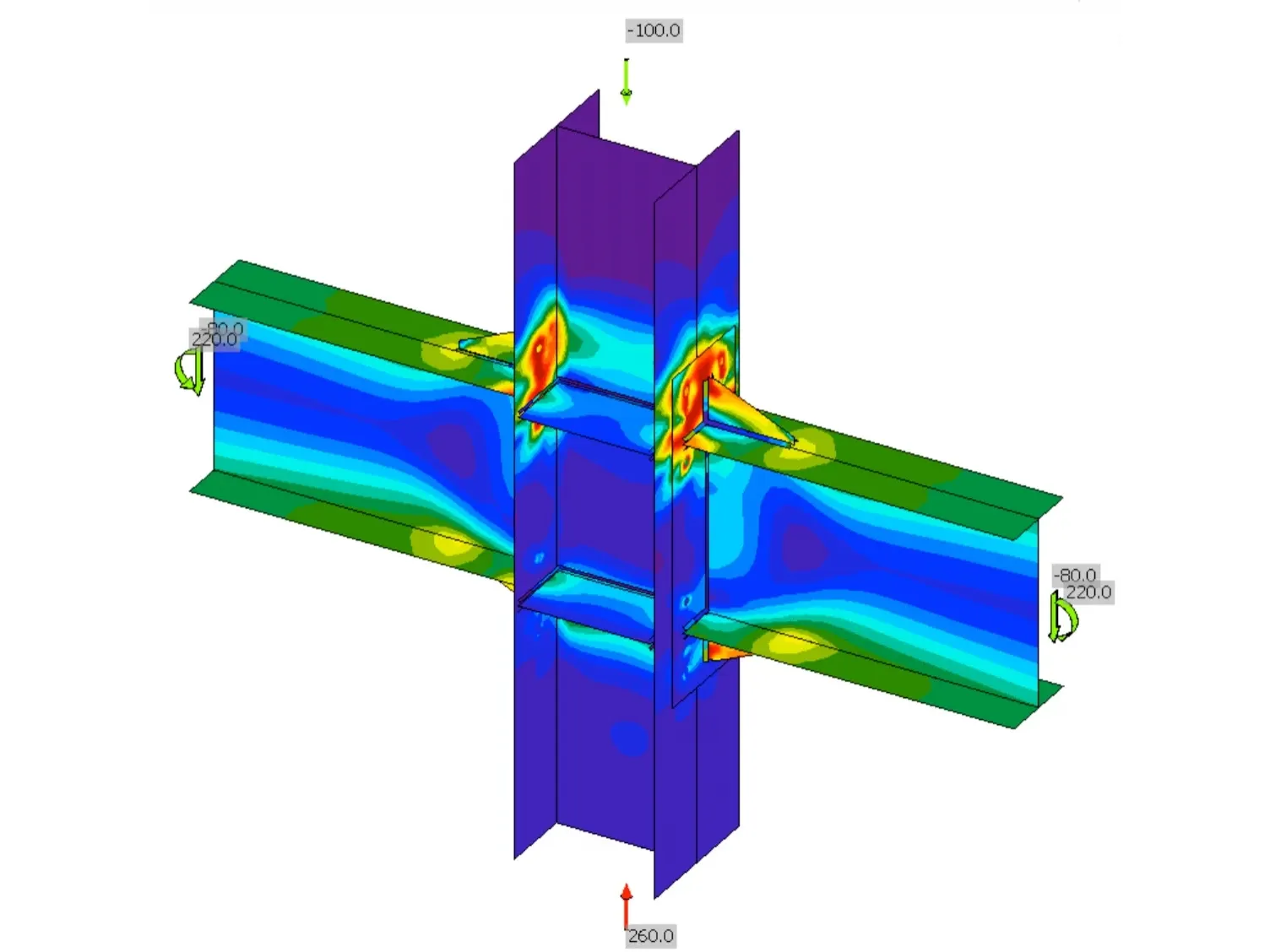
Stainless and aluminium parts often connect to a carbon steel frame or a concrete structure. Stainless-to-carbon steel welds use suitable dissimilar-metal consumables, and bolted joints are isolated where moisture is present. Anchors into concrete are designed to ACI 318 Chapter 17, with stainless anchors where the exposure needs them. Our steel connection design service covers these details.
Analysis and design
Each structure is modelled in three dimensions with the material properties of stainless steel or aluminium, under dead, imposed, wind, seismic and thermal load combinations to ASCE 7-16. Stainless members are designed to AISC 370 or EN 1993-1-4, aluminium members to the Aluminum Design Manual or EN 1999-1-1, carbon steel parts to AISC 360, aluminium welds to AWS D1.2, and anchorage to ACI 318, together with Dubai Municipality or the municipality of the project’s emirate.
What our stainless steel structure design consultants deliver
- A design basis covering the exposure, the grade or alloy, the finish and the loads
- Structural calculations for the members, connections, fixings and anchors
- Connection designs, including isolation details between different metals
- Design drawings and a material specification for grades, finishes, fasteners and fabrication
- Support reactions for the designer of the supporting structure
- Calculations and drawings for authority approval, with responses to comments
How a stainless steel or aluminium project runs
- You send the architectural drawings, the location and exposure, and the finish required.
- We agree the scope and the programme.
- We propose the material, grade and structural system, with options compared where useful.
- We complete the analysis, member design and connection design.
- We issue the calculations, drawings and specification for review and answer the comments.
Stainless steel and corrosion-led projects
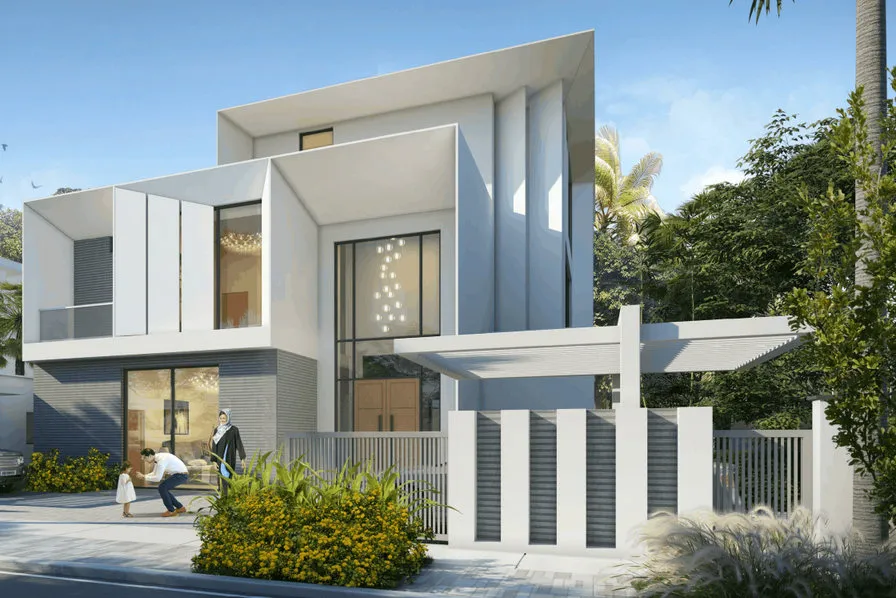
For Villa V-75 at Dubai Hills, Wrenze Steel was appointed by DAMAC Crescent Properties for the steel frames that carry the villa’s GRC fins and window surrounds, with stainless and galvanized fixings connecting each panel to the frame through fixed and sliding points that release thermal and building movement. Corrosion is a design parameter across our work, from the pool roofs at the Emirati School in Ajman, designed for warm, chlorinated air, to the coastal canopy at Cafe Del Mar in Abu Dhabi.
About Wrenze Steel
- Our engineers hold Dubai Municipality practice certificates, and we prepare Dubai Municipality submissions through to approval.
- A steel structure design consultancy: stainless steel and aluminium structures are part of our work alongside buildings, bridges and industrial structures.
- 96 projects completed across the UAE and the GCC.
- Our office is in Dubai Silicon Oasis, and we work across the UAE and the GCC.
Related pages
Steel design to AISC 360 · Steel design to Eurocode 3 · Tubular steel structure design · GRC support steel frames · All steel structure types
For a stainless steel or aluminium structure, contact our engineers.